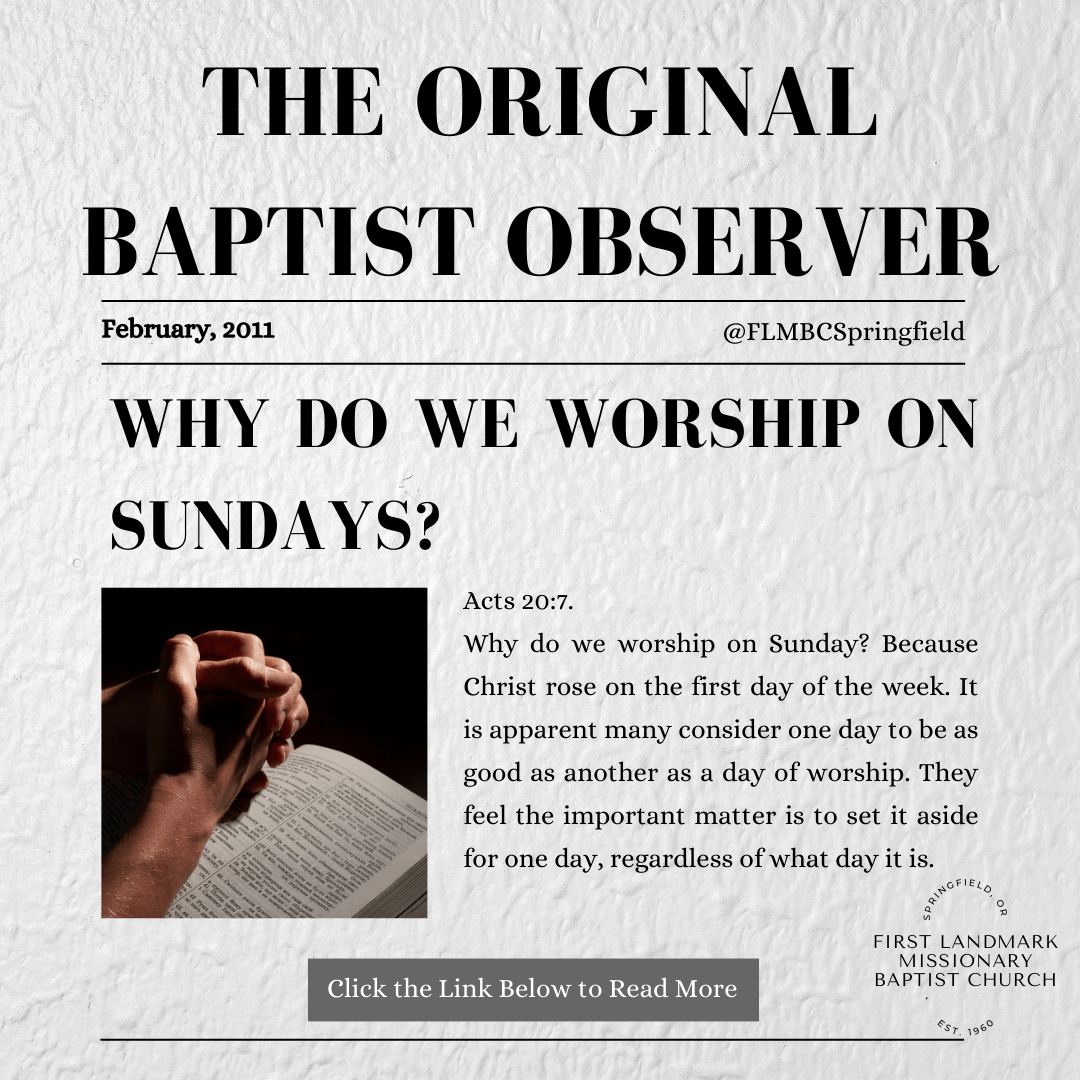
From the Original Baptist Observer, February, 2011 Issue
Acts 20:7
Why do we worship on Sunday? Because Christ rose on the first day of the week.
It is apparent many consider one day to be as good as another as a day of worship. They feel the important matter is to set it aside for one day, regardless of what day it is. For example, some churches now provide Saturday services to accommodate people leaving Sunday for travel, recreation, or any other personal activities.
At the same time, there are those who insist on a special day for worship, but they insist it is the Sabbath, or Saturday. Some of them insist anyone who doesn’t observe the Sabbath must consign them self to the category of false practice. It is evident they know little about the Sabbath, especially Paul’s warning against allowing people to judge according to one’s observance “of the Sabbath days”, Colossians 2:16.
God’s people should be able to worship the Lord any day of the week. However, Sunday, the first day of the week, needs always to be a special day of worship for the followers of Christ under the New Covenant. This is the day the Lord arose from the grave, Mark 16:9. In so doing, we recognize that the Lord made the first day of the week a special day of joy and gladness, Psalm 118:24.
Some Bible students see more than a passing remark in Matthew 28:1 and Mark 16:1. The latter refers to “when the Sabbath was past”. In view of the fact the Sabbath was for a particular time, in a particular location, with a particular climate, for a particular nation, Missionary Baptists should always reserve the first day of the week as a special time to worship. “Sabbath” by definition and Old Testament practice means “rest”, not “worship”.
By example, Christ appeared on the first day of the week. Most of the recorded appearances of Christ during the “forty days” after His resurrection, were on the first day of the week, Acts 1:3.
He made a number of appearances on the very day of His resurrection, the first day of the week. First, He appeared to Mary Magdalene early in the morning. (Mark 16:9; John 20:11-18) Second, He appeared to the other women who came to the tomb early that morning. (Matthew 28:9-10) They went to tell the disciples about His appearance. Christ instructed them regarding another appearance in Galilee. Third, He appeared individually to two disciples. One of whom seems to be Simon Peter. (Mark 16:12-13; Luke 24:13-34; 1 Corinthians 15:5) As soon as they recognized the Lord, He disappeared. Fourth, He appeared to the assembled disciples on the evening of His resurrection. (Luke 24:36-43; John 20:19-24) The apostle Thomas was absent from the assembly. One week later, again the first day of the week, the LORD appeared to the apostles with Thomas present. (John 20:26) Although Thomas had doubted the LORD’S resurrection, he accepted the evidence of this appearance. (John 20:28) Is there any doubt whether the LORD was displeased with the absence of Thomas that first LORD’S Day evening? Anyone who fails to assemble for worship on the LORD’S Day casts some doubt on the doctrine of His resurrection. On the other hand, anyone who worships the LORD on Sunday, in truth, acknowledges His resurrection.
The fact Christ met again and again with His disciples on the first day of the week, impresses many people with the belief it is an example to follow. This is another reason Missionary Baptist’s worship on Sunday.
Acts 2:1
Why do we worship on Sunday? Because of the Day of Pentecost.
Some do not realize the first day of the week was sometimes significant in the Old Testament in the law given by Moses. The offering of firstfruits was “On the morrow after the Sabbath” (Leviticus 23:10-11) This was the first day of the week. The offering of firstfruits foretold of Christ’s resurrection, thus the new day of worship. (1 Corinthians 15:20)
Also, that same day was important in computing the day of Pentecost, one of the most important annual observances of the Jews. (Leviticus 23:15-16) The word “Pentecost” is derived from the “fifty days”, in computing the day of its observance. The counting to determine the day of Pentecost was “from the morrow after the Sabbath”. It was on the first day of the week, also.
In other words, God chose the first day of the week to empower Jerusalem church to carry out the commission. He had promised Divine power, and He provided power on the seventh Sunday after the Lord’s resurrection. (Luke 24:49; Acts 1:8; 2:1-4) One could also recognize Sunday worship as acknowledging the LORD’S churches have the Spirit’s power to carry out the Great Commission.
Why do we worship on Sunday? Because of the Scriptural example.
At least one account of the commission to the Lord’s churches was given on the first day of the week. (John 20:19-21) Perhaps more of them were also, but John clearly gives an account of this on Sunday. Also, some insist Sunday is wrong because Christ observed the Sabbath. Christ did observe the Sabbath while He was alive, because He was “made under the law”. (Galatians 4:4) Further, He came to fulfill the law. (Matthew 5:17-18) However, at the cross He “took it out of the way, nailing it to His cross”. (Colossians 2:14) Consequently, the Bible does not record a single time the Lord observed the Sabbath after His resurrection. It does record how He honored the first day of the week.
Our text (Acts 20:7) indicates there was an assembly on Sunday in Troas. We’ve already seen evidence that the first day of the week was already the special day of worship for the LORD’S churches at that time.
The churches of Galatia and the church of Corinth were instructed to do their giving on the first day of the week. (I Corinthians 16:1-2) This was apparently the commonly practiced time, by these examples, for the LORD’S churches to meet for the worship of our resurrected Savior.
 The Original Baptist Observer
Leave a comment