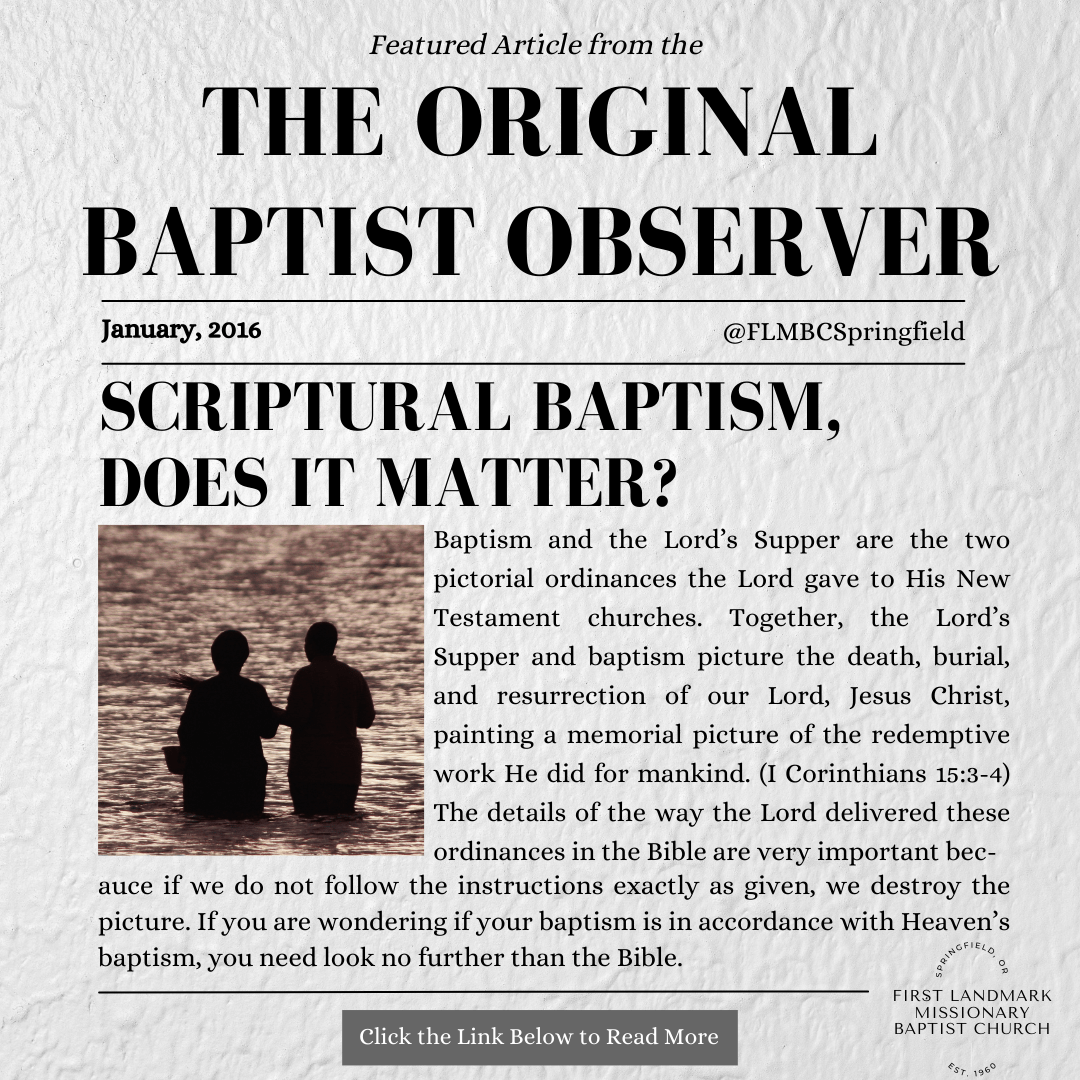
Baptism and the Lord’s Supper are the two pictorial ordinances the Lord gave to His New Testament churches. Together, the Lord’s Supper and baptism picture the death, burial, and resurrection of our Lord, Jesus Christ, painting a memorial picture of the redemptive work He did for mankind. (I Corinthians 15:3-4) The details of the way the Lord delivered these ordinances in the Bible are very important because if we do not follow the instructions exactly as given, we destroy the picture.
If you are wondering if your baptism is in accordance with Heaven’s baptism, you need look no further than the Bible. The Bible is God’s complete revelation to man and it contains all we need to know about spiritual matters. Let’s look at five different aspects to Scriptural baptism: mode, administrator, authority, candidate, and intent.
First, we will look at the “mode”, or manner, for a proper baptism. The Bible teaches baptism by complete immersion in water. John 3:23 says, “And John also was baptizing in Aenon near to Salim, because there was much water there: and they came, and were baptized.” We also have the example of our Lord’s baptism in Matthew 3, where Jesus “went up straightway out of the water”. We have the example of the Ethiopian eunuch in Acts 8:39, “And when they were come up out of the water,…” The most compelling teaching in the Bible on the proper mode for Scriptural baptism is in Romans 6:4 where it states that we are buried with Christ by baptism into (with reference to) death. A burial is a complete covering. If we try to bury someone by pouring dirt on their head or by sprinkling dirt on them, they will not get buried. Also note, that when you walk through a cemetery, you don’t see hands or noses sticking up out of the ground. A burial is a complete covering. To modify the picture of baptism by burial to sprinkling or pouring water on someone, destroys God’s picture and we must not do it. The only example we have for baptism is in water. (John 1:26, 33) Every example that we have is that both the candidate and the administrator are both in the water. (Matthew 3:6; Acts 8:39)
Next, we will look into the Bible teaching on a Scriptural administrator for baptism. Every instance of baptism in the Bible is performed by a God-called, ordained bishop. The Apostle Paul, John the Baptist, Cephas, Moses as an Old Testament picture, and Philip all fit these qualifications to baptize. We will look at Philip’s work since many accuse him of being a “baptizing deacon” rather than an ordained bishop. In Acts 6, the Jerusalem Church called out seven men from among themselves, to serve in the office of deacon for that church body. After the persecution of Stephen, Acts 7 & 8, the church was scattered abroad into the regions of Judaea and Samaria, except the Apostles. We see Philip going to the city of Samaria where he preached and baptized. For him to baptize means that the Jerusalem Church had ordained him as a bishop before he left Jerusalem. We see as we trace his path from Samaria to Gaza to Azotus, Acts 8:40, that on his journey he preached in all the cities till he came to Caesarea, his final destination. We see later in Acts 21:8, where he is referred to as “Philip the evangelist”. We also see in that verse that Philip “was” one of the seven. This is the Greek work ek, which means called out from among. In a modern day parallel, New Testament churches sometimes have men who are ordained bishops sent out as missionaries with authority to baptize.
The third aspect of Scriptural baptism we will explore it the necessity of proper authority to baptize. The Lord placed HIs authority to baptize in His New Testament churches only. (Matthew 28:16-20; Mark 16:15; John 20:21; Acts 1:8) Notice that Jesus did not give them carte-blanche. He gave them the power and authority to perform teaching, preaching, and baptizing only as He had ordained, or commanded. He made His commands clear in His Word. Authority was very important to people in Bible times. Notice the conversation in Mark 11 between the chief priests, scribes, elders, and Jesus. They asked Him by what authority He did those things. Jesus answered with a question about John the Baptist’s authority to baptize. To be Heaven’s baptism, according to the Scriptures, any baptism after John was cast in prison must come by the authority that comes through one of the Lord’s local, New Testament churches. To be one of the Lord’s, a church must have lineage back to the Jerusalem church by church succession. This lineage is important because as we see across God’s creation, “like begets like”.
The fourth and fifth aspects to Scriptural baptism are closely linked and we will explore them together. For Heaven’s baptism to take place, a person must already be saved. We see in the Scriptures that baptism always followed salvation, as in the case of the Ethiopian eunuch in Acts 8, Saul in Acts 9, the Philippian jailor in Acts 16, and Lydia in that same chapter. God even shows us someone who was baptized who was never saved in Simon the sorcerer in Acts 8. Even after being baptized, Simon was still in the “gall of bitterness and in the bond of iniquity” demonstrating that baptism itself does not save anyone. Only faith in the Lord, Jesus Christ can save. John the Baptist demanded “fruits meet for repentance” before he would baptize the Pharisees and Sadducees in Matthew 3. The pattern holds true even in our Lord’s baptism. He was already the Son of God before His baptism. His baptism showed forth His intention to get started on the business of calling out His church. This leads us to the fifth aspect of Scriptural baptism. That is the proper intent of the saved candidate after baptism. The only intention acceptable to God is the desire to join himself to the church body and serve the Lord in Spirit and truth. (John 4:24) The intention must be to “put on Christ”. (Galatians 3:27)
In order to meet God’s qualifications, baptism must be followed to the very letter. Our Lord has spelled out the specifics to us clearly. Why would God be so narrow? Because He knows man’s frame, that we are dust. (Psalm 103:14) The picture of baptism is clear. If man modifies it, he destroys God’s perfect picture. Psalm 19:7-11 says it clearly,
“The law of the LORD is perfect, converting the soul: the testimony of the LORD is sure, making wise the simple. The statutes of the LORD are right, rejoicing the heart: the commandment of the LORD is pure, enlightening the eyes. The fear of the LORD is clean, enduring for ever: the judgments of the LORD are true and righteous altogether. More to be desired are they than gold, yea, than much fine gold: sweeter also than honey and the honeycomb. Moreover by them is thy servant warned: and in keeping of them there is great reward.”
 The Original Baptist Observer
Leave a comment