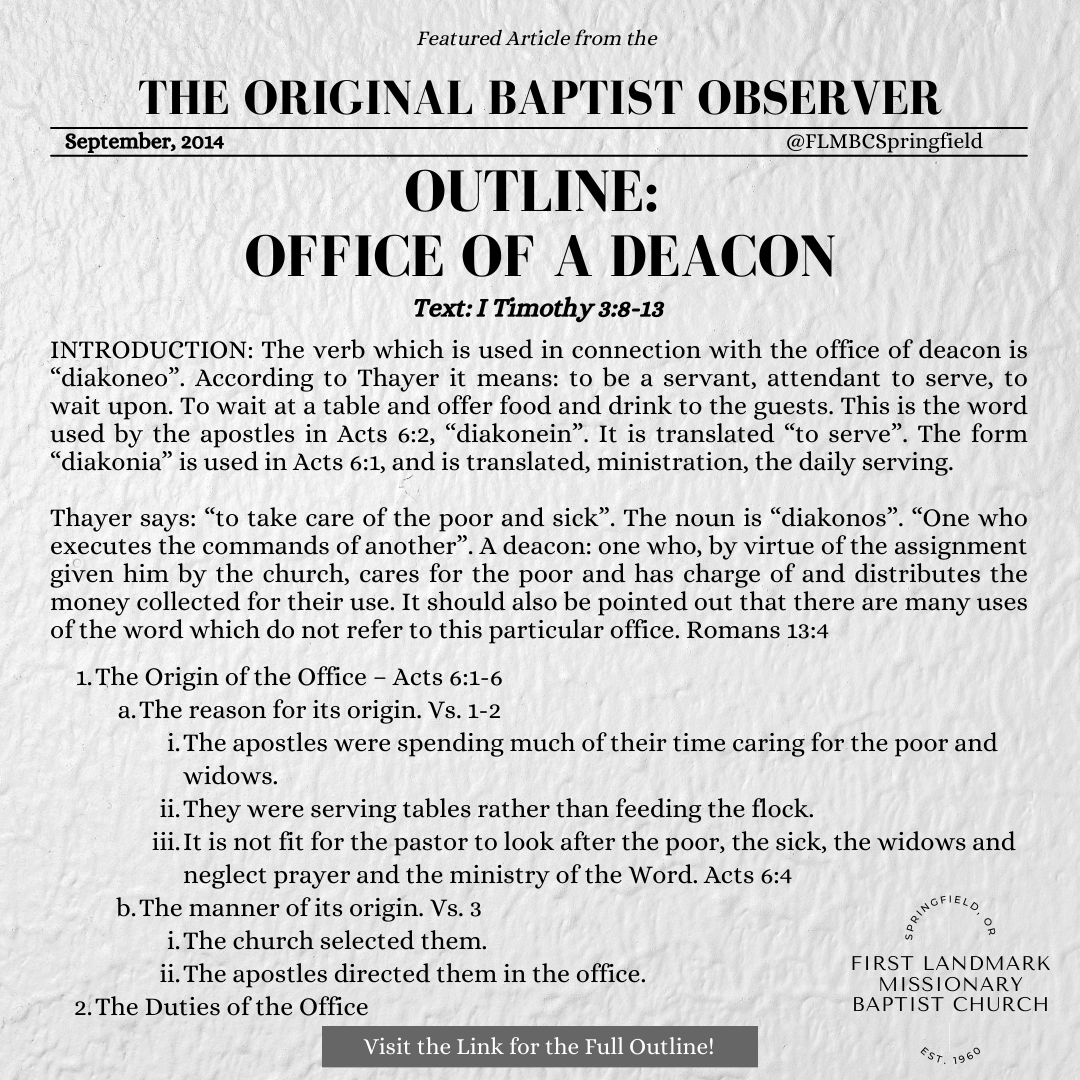
From the Original Baptist Observer, September, 2014 Issue
Text: I Timothy 3:8-13
INTRODUCTION: The verb which is used in connection with the office of deacon is “diakoneo”. According to Thayer it means: to be a servant, attendant to serve, to wait upon. To wait at a table and offer food and drink to the guests. This is the word used by the apostles in Acts 6:2, “diakonein”. It is translated “to serve”. The form “diakonia” is used in Acts 6:1, and is translated, ministration, the daily serving.
Thayer says: “to take care of the poor and sick”. The noun is “diakonos”. “One who executes the commands of another”. A deacon: one who, by virtue of the assignment given him by the church, cares for the poor and has charge of and distributes the money collected for their use. It should also be pointed out that there are many uses of the word which do not refer to this particular office. Romans 13:4
- The Origin of the Office – Acts 6:1-6
- The reason for its origin. Vs. 1-2
- The apostles were spending much of their time caring for the poor and widows.
- They were serving tables rather than feeding the flock.
- It is not fit for the pastor to look after the poor, the sick, the widows and neglect prayer and the ministry of the Word. Acts 6:4
- The manner of its origin. Vs. 3
- The church selected them.
- The apostles directed them in the office.
- The reason for its origin. Vs. 1-2
- The Duties of the Office
- The first deacons were selected to serve tables of the poor and widows.
- Simmons says in his book, A Systematic Study of Bible Doc-trine, “Let it be born in mind that deacons are servants, according to the meaning of the title, and not bosses. They are to take instructions from the church rather than dictating to the church. They are to help the pastor rather than telling him what to do. Let them remember that their office is subordinate to that of the pastor.”
- The first deacons were selected to serve tables of the poor and widows.
- The Qualifications of the Office
- As given in Acts 6
- Full of the Spirit – empty of self
- Full of wisdom – James 1:5
- Men of good report – good reputation
- As given in I Timothy 3:8-13
- Grave – serious minded, honorable
- Not double tongued
- Not given to much wine
- Not greedy of filthy lucre – He must not love money because he might misappropriate that which is entrusted to his care and designated to the poor.
- Sound in the faith – Vs. 9
- Must prove himself – I Timothy 5:22; 3:6
- Must have a qualified wife – Vs. 11
- Must have a proper home life – Vs. 12
- As given in Acts 6
- The Reward of the Office – Vs. 13
 The Original Baptist Observer
Leave a comment